Why You Can’t Relax Anymore
When Rest Feels Uncomfortable and Your Mind Won’t Power Down
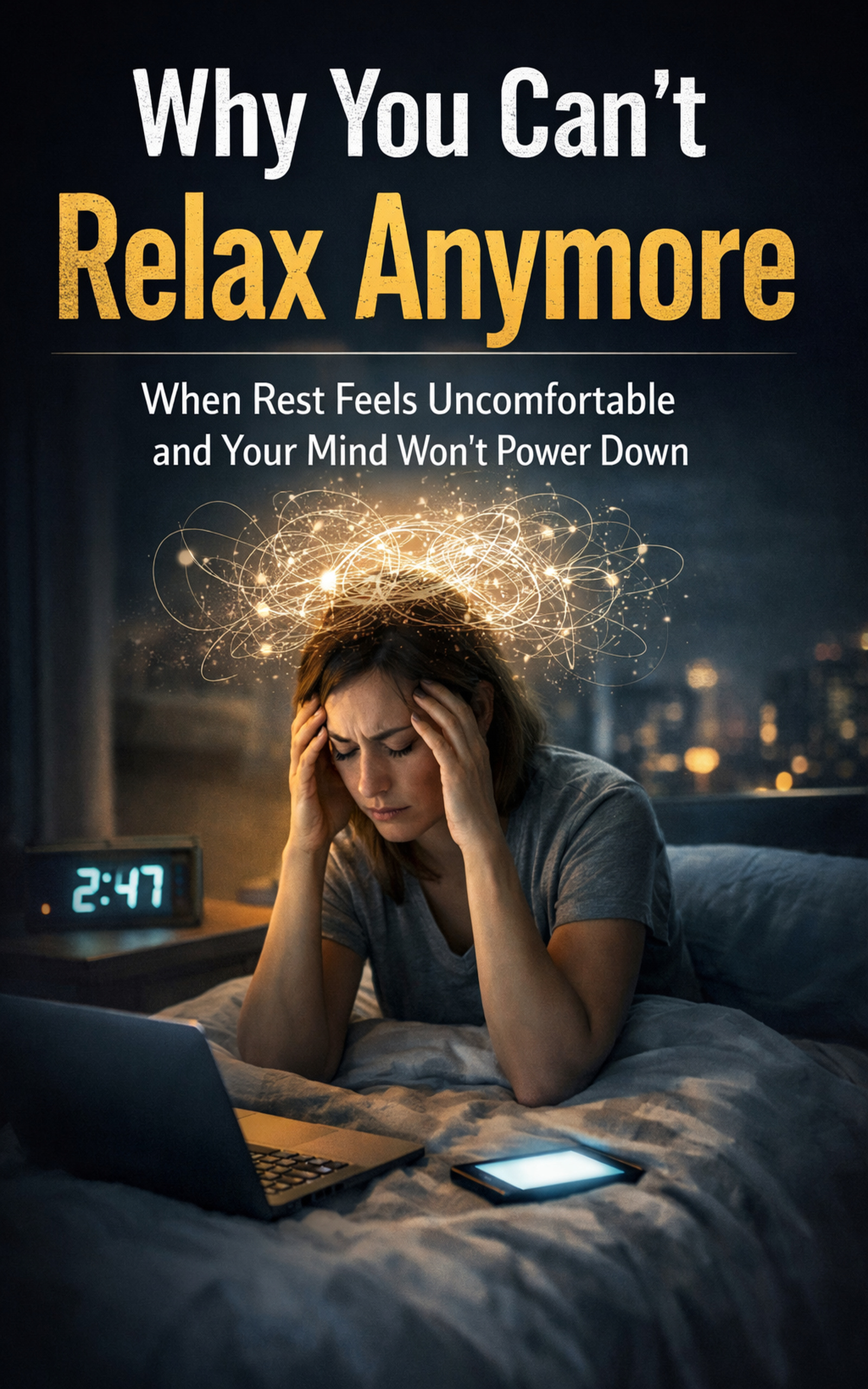
Some people finally get time off and feel more tense, not less. The body slows down, but the mind keeps scanning for what is next, as if rest is something you have not earned yet.
This book explains why that happens after long periods of pressure. It breaks down how alertness becomes your baseline, how quiet moments can trigger unease, and how guilt and productivity habits can make downtime feel unsafe.
Instead of forcing relaxation, you will learn gradual ways to shift state. The tools are practical, non clinical, and designed for real life, so you can build an off switch that works without turning rest into another task.
- Understand why rest can feel unfamiliar after long periods of stress.
- Learn how hyper focus and problem scanning become default habits.
- Recognise the signals that you are pausing physically but not resting mentally.
- Learn small transition steps that make downtime feel safer over time.
Overview
When rest feels uncomfortable, it is often because your system has learned that being on is safer than being still. After weeks, months, or years of pressure, quiet can register as a threat, not a relief.
This book helps you understand that pattern in plain terms. You will map what keeps you keyed up, then practice small, repeatable shifts that teach your mind and body what a real pause feels like.
Who this book is for
This is for you if you sit down to rest and feel restless, guilty, or strangely tense. You may keep checking your phone, mentally rehearsing tasks, or looking for problems to solve because doing nothing feels wrong.
It is also for people whose lives have been shaped by deadlines, caretaking, or constant responsibility. If slowing down makes you uneasy, and relaxation feels like another performance, the tools here give you a calmer way back to rest.
How to use this book
Use this book like a set of small experiments. Read a section, choose one practice, and repeat it for a few days. The aim is not to force a perfect calm, it is to make rest feel a little more tolerable and a little more available.
Start with the chapter that matches your biggest friction, racing thoughts, body tension, rest guilt, or the habit of staying busy. Keep your steps small. The methods work best when they are easy enough to do on an ordinary day.
What you will learn
- Why rest can trigger vigilance, even when you want to switch off.
- How pressure habits keep your attention locked onto problems and next steps.
- How to recognise the difference between pausing and genuinely recovering.
- Simple ways to reduce the false urgency loop created by constant inputs.
- Low pressure transition rituals that help you shift from doing to resting.
- Technology and boundary rules that lower baseline alertness.
- A gentle plan for rebuilding comfort with downtime over time.
Frequently asked questions
Is this a relaxation program or a guarantee
No. This is an informational guide with practical tools and exercises. It aims to help you understand what keeps you on and to practice gradual changes, not to promise a specific result.
Is this clinical, medical, or therapy based
No. The approach is non clinical and focused on everyday patterns, habits, and practical experiments you can run in daily life.
What if rest makes me feel guilty or lazy
That reaction is common when your identity has been built around being useful or productive. The book shows how guilt forms, how it hijacks downtime, and how to rebuild rest as something functional rather than something you have to justify.
What if my mind keeps planning, rehearsing, or scanning for problems
The book explains why the mind keeps doing that when your baseline state is readiness. You will learn short resets and transition steps that lower scanning without trying to control every thought.
What if I feel tense in my body even when nothing is happening
It covers how alertness can stay in the body, even when you have a break. You will learn to notice early signals, reduce friction, and use small sensory cues that help your system read rest as safe.
Is this suitable if I want simple steps, not complicated techniques
Yes. The tools are designed to be simple and repeatable. You can use one small practice at a time and build from there.
Get the book
Available on Amazon in ebook and paperback formats.