Why Work Follows You Home
Why You Can’t Switch Off From Work and How to Mentally Disconnect
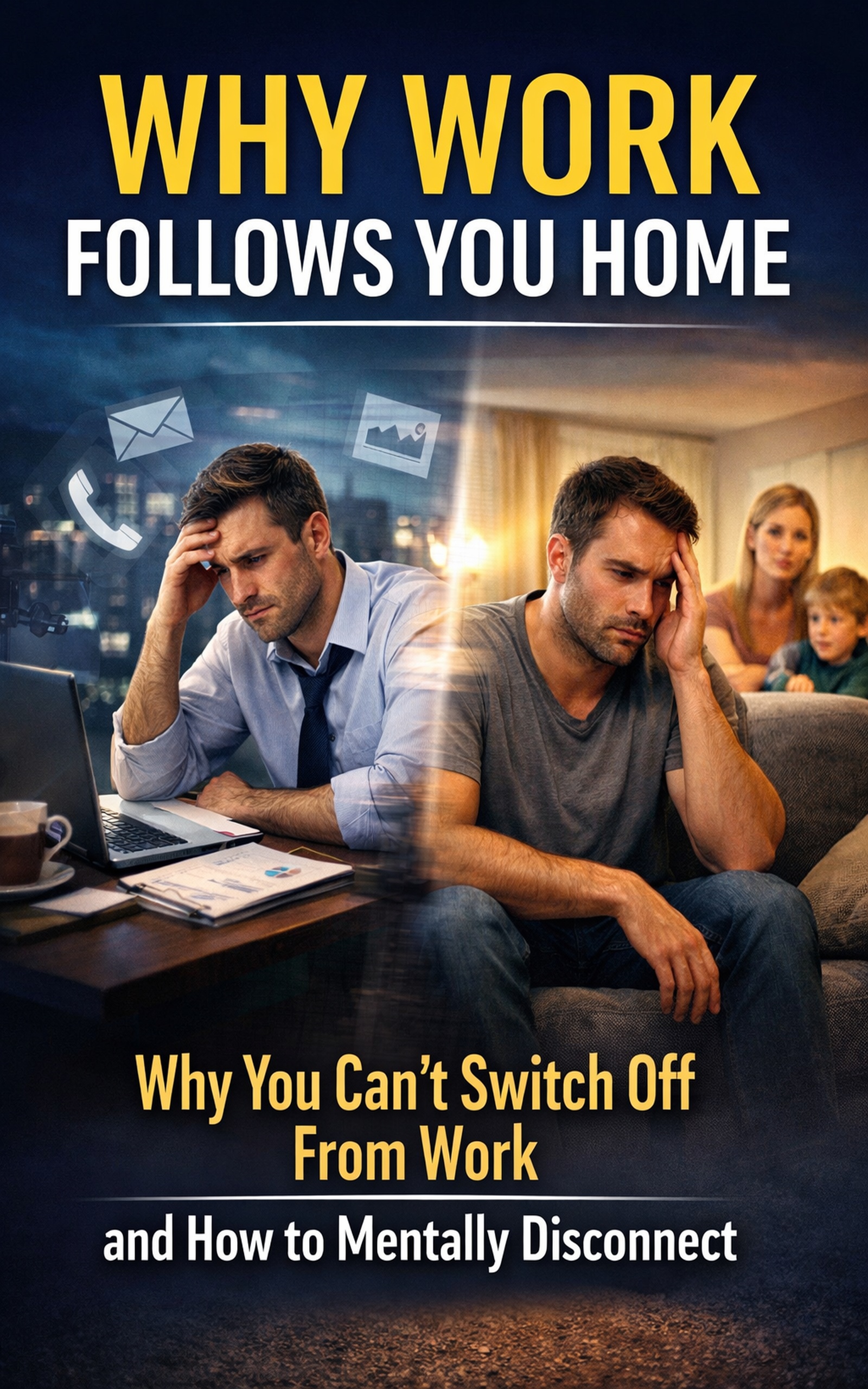
Some work stress does not stop when the day ends. You close the laptop, but your mind keeps reviewing tasks, replaying conversations, anticipating problems, and staying ready for the next message. This book explains why switching off can feel impossible, even when you are exhausted, and how work can become a default mental background. It then shows practical ways to create separation again, using clearer endpoints, fewer open loops, and simple reset steps that help your brain understand that work is over.
- Understand why your mind stays on call after work, even when nothing urgent is happening.
- Learn how open loops and unfinished pressure keep attention locked to work.
- Recognize the habits that pull you back in, checking, scanning, rehearsing, and pre solving.
- Use simple disconnect routines that reduce spillover and create clearer separation.
Quick tools
- Close the loop. Write the next step for each open task, then stop thinking about the whole project.
- Create a hard endpoint. Pick a short shutdown ritual, last message check, plan tomorrow, then transition.
- Use a reset cue. Change room, change clothes, or take a short walk to mark the shift out of work mode.
Overview
When work follows you home, it can feel like you are never fully off duty. Even in quiet moments your attention keeps drifting back to what is unfinished, what might go wrong, or what you need to remember for tomorrow.
This book breaks down why mental spillover forms, why your brain treats work like an ongoing risk to manage, and why relaxing can start to feel unsafe or wasteful. It then offers a practical approach to disconnecting, with clearer endpoints, fewer open loops, and repeatable habits that rebuild separation without trying to force calm.
Who this book is for
This book is for people who leave work physically but not mentally. If evenings and weekends are filled with checking, replaying, planning, and bracing, and you cannot switch off even when you want to, this guide is written for you.
- You finish work, but your mind keeps running through tasks and problems.
- You feel guilty resting because there is always more to do.
- You keep checking messages or thinking you might have missed something.
- You struggle to be present at home because work keeps pulling you back in.
- You want practical separation, not vague advice to relax.
How to use this book
Start with the sections that explain why switching off is hard, so you can stop treating it as a personal failure. Then move into the parts on open loops and endpoints, because reducing unfinished pressure changes what your evenings feel like.
Use the tools as small experiments. Pick one loop closing habit, one shutdown step, and one boundary that protects your non work time. Repeat long enough to build a new default, rather than judging progress by perfect evenings.
- Use the “patterns” sections to identify what pulls you back into work mode.
- Write next actions to close loops, so your brain stops trying to hold everything.
- Create a consistent shutdown routine that marks work as finished for the day.
- Review weekly using practical markers, less checking, fewer late work thoughts, easier transitions.
What you will learn
- Understand why your mind stays in work mode after hours.
- Learn how open loops and ambiguity keep attention hooked.
- Recognize the difference between planning and rumination about work.
- Learn why constant availability makes switching off harder over time.
- Use simple methods to close loops without finishing everything.
- Create clearer endpoints that reduce mental spillover into evenings and weekends.
- Build boundaries that protect recovery without relying on willpower.
FAQ
Why can’t I switch off even when I am tired?
Your brain treats unfinished work like an open problem. When tasks feel unclear or high stakes, attention stays active to prevent mistakes and future stress. The book shows how to reduce that signal by creating clearer next steps and endpoints.
Is it normal to keep replaying work conversations at home?
Yes. Replay is often a way of trying to regain control, predict reactions, or prevent repeat discomfort. The goal is not to ban thinking, it is to interrupt the loop by closing what is actionable and letting the rest stand.
What if I genuinely have too much to do?
The book does not pretend workload is always optional. It focuses on separation methods that still work when work is heavy, like choosing a stopping rule, writing next actions, and reducing the number of unresolved threads you carry.
Should I avoid checking messages completely?
Not always. For some roles, complete avoidance is unrealistic. The book focuses on structured checking, one planned window, then a clear stop, so you do not stay in a constant on call state.
How do I know it is working?
Look for practical shifts, fewer message checks, less background rehearsal, easier transitions into home time, and more moments where attention stays with what you are doing. The book treats these as early signs that separation is returning.
Get the book
If work keeps running in your head after hours, this book gives you a clear explanation of why it happens and what helps you disconnect. You will learn how to close loops, create stronger endpoints, and rebuild separation between work and the rest of your life.