Why Burnout Makes You Overthink and How to Break the Cycle
Why Your Mind Won’t Switch Off When You’re Drained and How to Reset It
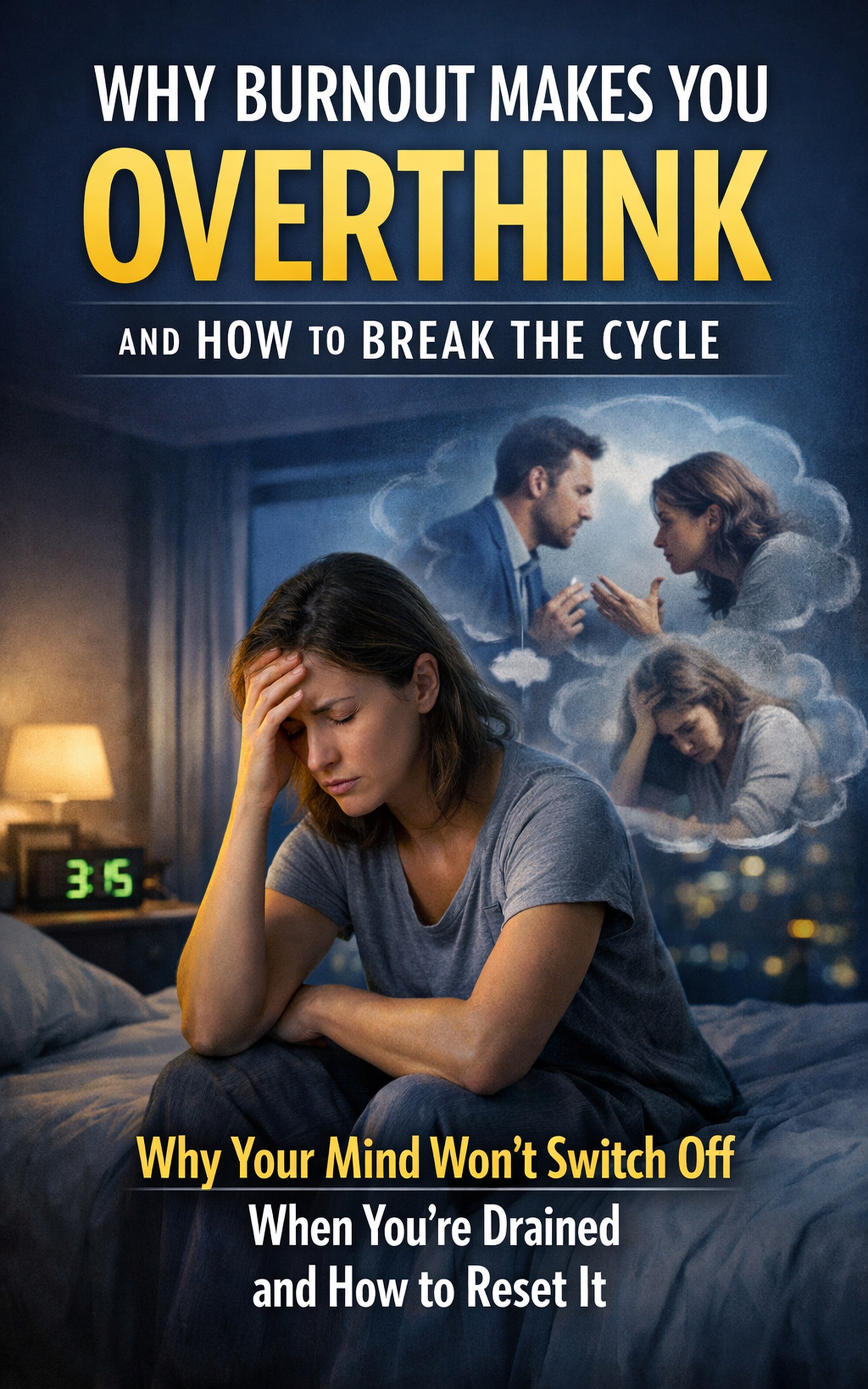
Burnout does not just make you tired. It changes how your mind handles uncertainty, loose ends, and emotional charge. When capacity drops, your brain often tries to regain control by replaying, analysing, and scanning for what you missed. This book explains why rumination shows up when you are depleted, what keeps it running, and how to interrupt the loop with simple resets that do not require high energy.
- Understand why exhaustion makes thoughts feel louder and more urgent.
- Learn how rumination is fuelled by stress chemistry, not poor willpower.
- Recognize common triggers and choose a response that fits the moment.
- Use low effort closure rituals that help your mind stop negotiating.
- Build daily routines and boundaries that reduce replay over time.
Start here
Take four seconds to inhale and six seconds to exhale. Add a neutral label like “thinking” as you breathe out. Repeat for one minute, then choose one small next step instead of solving the whole problem.
Overview
When you are burned out, your mind becomes less flexible. It has less fuel for perspective, problem solving, and emotional regulation, so it defaults to threat scanning and repeated analysis. Overthinking can look like planning, but it often functions as an attempt to create certainty when your system does not have the energy to tolerate uncertainty.
This book breaks rumination down into clear mechanics. You will see how depletion, stress, and unresolved pressure points combine to keep thoughts circling. You will also learn practical ways to interrupt the loop, bring your body back to the present, and create closure without forcing yourself to “calm down”.
Who this book is for
This is for you if your thoughts become harder to stop when you finally sit down. If you replay conversations, re run decisions, or plan in circles even though you feel tired, this is a sign your system is trying to reduce risk with the limited energy it has left.
It is also for people who function well in the day and unravel at night, people who feel stuck in “mental fixing”, and people who want a grounded approach that fits real life, not an ideal routine.
How to use this book
Read it in short sections and treat it like a toolkit. Start with the chapters that match your current pattern, then keep one or two resets available for the moments your mind ramps up.
The goal is not perfect control. The goal is a repeatable response that lowers intensity, creates a clean ending, and saves energy for recovery. Practice the techniques when you are relatively steady, so they are easier to access when you are not.
What you will learn
You will learn how burnout shifts attention and amplifies uncertainty. You will learn why rumination feels compelling in the moment, and why it rarely produces a true solution when your system is depleted.
You will also learn practical responses for common triggers, quick body based resets you can do in minutes, and simple closure rituals that tell your mind the episode is finished. Finally, you will learn daily routines and boundary choices that reduce the conditions that feed replay.
FAQ
Why does overthinking get worse when I am tired
Fatigue reduces your ability to hold ambiguity. When your system is low, your brain tries to narrow risk by rechecking, rehearsing, and analysing. It can feel like problem solving, but it is often a stress response that runs on repetition.
What is the difference between reflecting and ruminating
Reflection tends to produce a next step and then quieten. Rumination repeats the same material with rising urgency, but without new information. A useful cue is whether you feel more oriented after thinking, or more stuck and charged.
What do I do when my mind is looping and I have no energy
Use a low effort interrupt first. Slow breathing with a neutral label, orienting to your senses, or a short body scan can reduce the intensity enough to choose one small action. Then use a closure cue, a short phrase or physical reset, to mark the end of the episode.
Why do I replay conversations after meetings or conflict
After a charged interaction, your nervous system can stay activated. Replay is often an attempt to regain safety, rewrite the moment, or prevent it happening again. A short post event routine helps your system stand down and reduces the urge to keep reprocessing.
Will routines and boundaries really change this pattern
Interrupts help in the moment, but long term change comes from reducing the overall load. When you protect recovery, reduce decision overload, and build simple daily steadiness, your mind has less reason to keep scanning for control.
Get the book
If you want a practical, low pressure way to understand burnout driven overthinking, and you want a set of responses you can use when energy is low, this guide will walk you through the why and the how in a grounded, step by step way.