Stop Overthinking Conversations
How to Break Mental Replays and Let Go of What You Said
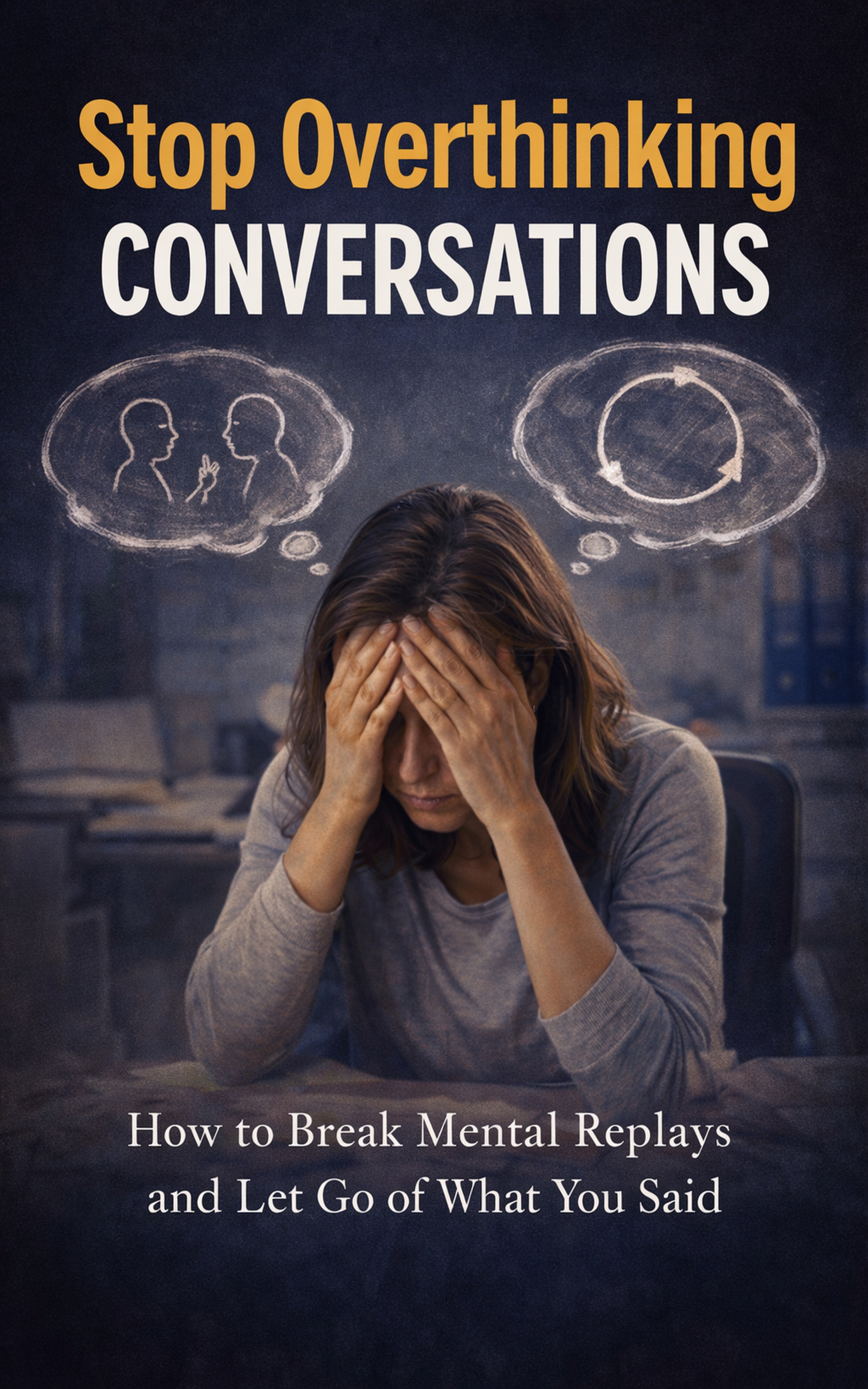
This book is for the moment after an interaction ends, when your mind keeps going. You replay your words, scan for mistakes, imagine how you came across, and feel pressure to fix something that is already in the past. It breaks down why replays happen, how the loop builds step by step, and what to do in the first minutes and hours so the spiral does not become your evening.
- Understand why social moments can feel high stakes, even when nothing is wrong.
- Learn to spot the trigger that starts a replay, before it gathers speed.
- Recognize when you are “learning” and when you are punishing yourself.
- Use simple closure routines that let your attention return to the present.
Quick tools
- Name the pattern, “replaying,” then switch to a short sensory task for one minute.
- Write one sentence of learning, then stop processing and return to your day.
- Use a neutral clarification script once, then accept the answer and move on.
Overview
Conversation replays often feel like responsible reflection, but they can turn into a search for certainty that never ends. A small cue, a pause, a facial expression, or a single sentence can become “evidence” that you did something wrong, even when the facts are thin. This book explains the replay loop in clear stages, then gives you practical ways to interrupt it. You will learn how to create closure, choose one proportionate action when needed, and stop feeding imaginary outcomes when nothing can be solved in your head.
Who this book is for
This book is for people who leave everyday interactions feeling tense, exposed, or unsure, even when the conversation looked normal from the outside. If you regularly revisit what you said, rewrite lines in your head, or keep checking the same moment for meaning, this will feel familiar.
- People who replay work conversations, meetings, feedback, or short messages.
- People who overanalyze tone, silence, facial expressions, and “what that meant.”
- People who feel stuck between wanting to learn and wanting to stop thinking about it.
- People who want practical routines, not motivational talk or pressure to be perfect.
How to use this book
Read it in order if you want the full model of how replays form and why they persist. If you want relief quickly, start with the in the moment techniques and the after conversation routines, then come back to the earlier chapters when you have more space.
Use the tools as small experiments. Pick one interrupt for the first minute of a replay, one boundary for reviewing, and one closure routine for later. Keep it simple, repeat it often, and adjust only after you have practiced it for a few days.
- Use the trigger steps to catch the loop early, before it turns into a full replay.
- Use short time limits so “processing” does not become hours of searching.
- Use one clear follow up action when needed, not multiple imagined conversations.
- Build a small set of scripts for common situations, then rely on them.
What you will learn
- Understand how your brain fills gaps with interpretation and turns it into “proof.”
- Learn how emotion tags a memory and keeps pulling you back to the same moment.
- Recognize common replay triggers across work, family, dating, and conflict.
- Learn quick interrupts that prevent a replay from building intensity.
- Recognize the difference between a useful review and a rumination habit.
- Use closure routines, time rules, and simple templates for proportionate follow ups.
- Build longer term resilience through practice, attention protection, and kinder self talk.
FAQ
Why do I replay conversations that were not even “important”?
Replays can start from uncertainty, not importance. When your mind cannot tell whether something was safe or risky socially, it keeps scanning the memory for answers, even when there is no clear answer to find.
How do I know if I should follow up or let it go?
Look for one concrete need. If there is a clear misunderstanding or a specific next step, choose one simple follow up and do it. If you only have vague discomfort and changing interpretations, a closure routine is usually the better move.
What if my memory keeps changing each time I replay it?
That is a common sign you are reconstructing, not recovering. The more you replay, the more the scene can become a story shaped by emotion. The goal is not perfect recall, it is ending the loop.
Do I need to challenge every thought to stop the replay?
No. This book focuses on interrupting attention patterns and lowering the fuel of the loop, instead of arguing with each line in your head. You will use brief labels, grounding, limits, and closure.
What if I keep needing reassurance?
Reassurance can calm you in the moment, but it can also train the loop to return. When you do check with someone, keep it brief and factual, then treat it as the end of the review rather than the start of another cycle.
Get the book
If you are tired of carrying conversations around in your head, this book gives you a clear model of what is happening, plus small tools you can use immediately. Start with one interrupt and one closure routine, then build from there.