Decision Fatigue and Mental Overload
Why Everything Feels Hard and What Actually Helps
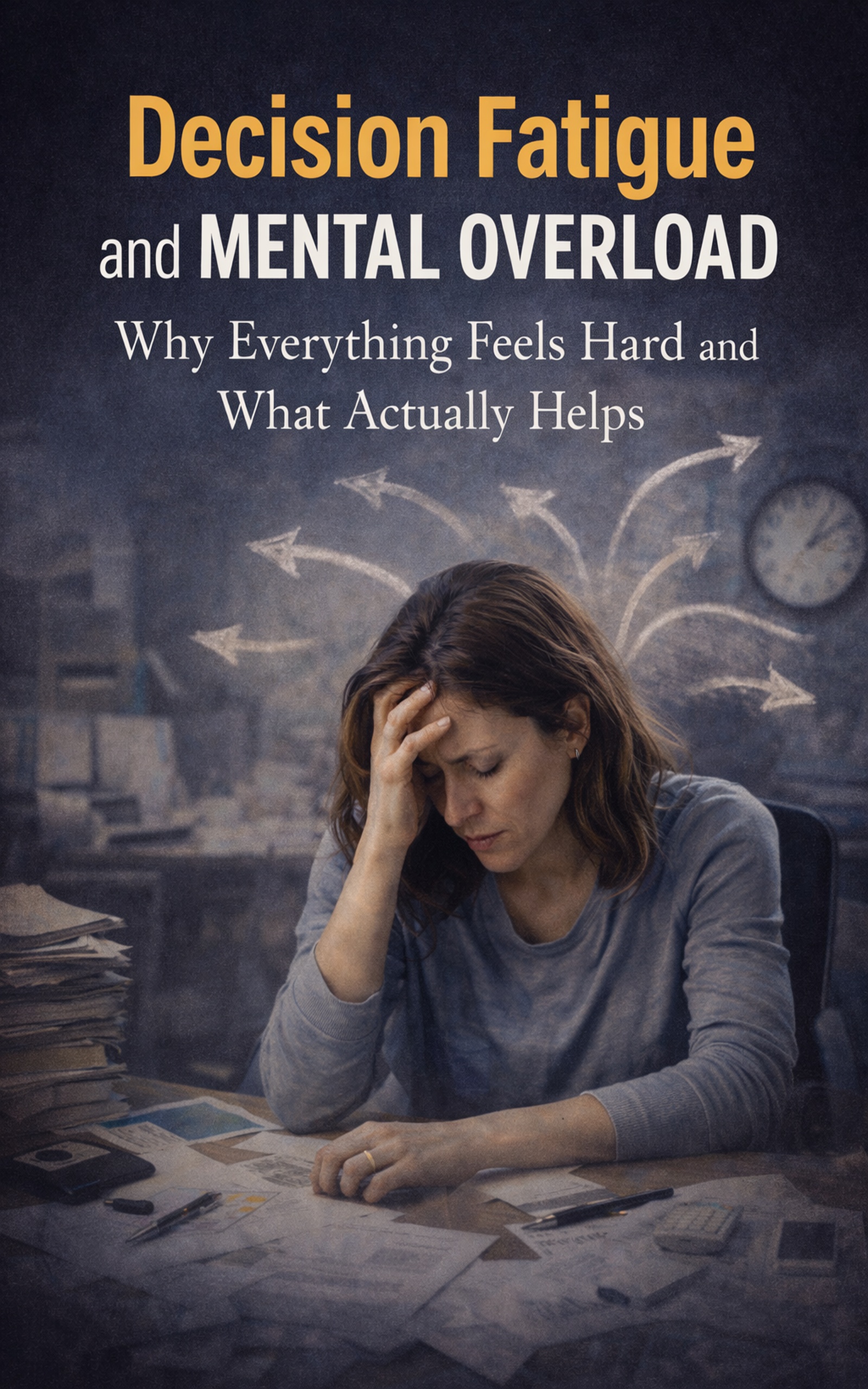
Decision fatigue is not laziness. It is what happens when attention, working memory, and self control are asked to carry too much for too long. You start treating every choice as urgent, second guessing simple steps, and avoiding tasks because the deciding feels worse than the doing. This book explains what is happening in clear stages, then gives practical ways to reduce cognitive load. You will learn how to build defaults, use simple decision rules, and design your days so fewer choices compete for the same limited mental bandwidth.
- Understand how overload builds through options, interruptions, and open loops.
- Learn how attention and working memory get stretched until choices feel impossible.
- Recognise common triggers at work, at home, and in relationships.
- Use small frameworks, defaults, and boundaries that reduce deciding without losing control.
Quick tools
- Do a one minute reset. Stop, breathe slowly, then choose one next action that takes under five minutes.
- Use a decision cap. Pick a short list of daily decisions you will make, then rely on defaults for the rest.
- Close open loops on paper. Write what is pending, choose one item, then schedule or park the others.
Overview
When mental load is high, your brain stops sorting priorities well. Small choices begin to feel heavy, you lose momentum, and you can end up cycling between planning, checking, and postponing. Over time, even ordinary days can feel like a constant stream of decisions with no recovery.
This book breaks down the mechanics behind that state, including attention limits, working memory strain, and the way stress and constant inputs drain self control. It then turns those ideas into practical strategies, so you can reduce the number of decisions you face, simplify what your brain has to hold, and rebuild clarity through smaller, repeatable steps.
Who this book is for
This book is for people who feel mentally saturated. You can still function, but everything takes too much effort. You put off simple tasks, overthink small choices, and feel irritated by options that other people seem to decide quickly.
- People who feel stuck because every choice has consequences in their head.
- People juggling work demands, home responsibilities, and constant inputs.
- People who start many tasks but keep losing traction and switching.
- People who want practical structure, not pressure, guilt, or hype.
How to use this book
Read it in order if you want the full picture of how decision fatigue develops, and why it shows up differently across work, home, and relationships. If you need relief quickly, start with the moment to moment tools and the quick decision frameworks, then return to the earlier chapters later.
Treat the strategies as small experiments. Pick one default to reduce daily choices, one rule to simplify a repeated decision, and one reset tool to use when you notice the shutdown feeling. Keep the changes small enough to repeat, because repetition is what turns a technique into a habit.
- Use the trigger list to notice overload early, before you spiral into avoidance.
- Use time limits so decisions do not expand to fill the whole day.
- Batch similar tasks so your attention is not constantly switching.
- Create shared systems so load is not held by one person indefinitely.
What you will learn
- Understand what decision fatigue is, how it feels, and why it gets misread as a motivation problem.
- Learn how attention, working memory, and self control interact when you are overloaded.
- Recognise the everyday sources of cognitive load, including alerts, invisible tasks, and constant switching.
- Learn practical ways to reduce choices through defaults, rules, checklists, and clear constraints.
- Use simple frameworks to make decisions faster, with less second guessing and less backtracking.
- Build recovery routines and boundaries that protect mental bandwidth across busy periods.
- Design longer term systems so the same problems stop returning every week.
FAQ
Why does everything feel harder than it should?
When your mental workspace is full, your brain cannot hold options, compare them, and plan cleanly. Tasks that were once simple start to feel like a chain of decisions, and that extra friction makes action feel heavy.
Is decision fatigue the same as being indecisive?
Not exactly. Indecision is often about uncertainty. Decision fatigue is often about capacity. You may know what you want, but your mind resists the effort of choosing, organising, and following through.
What makes decision fatigue worse?
Constant inputs, interruptions, unclear priorities, emotional strain, poor sleep, and too many open loops. Even small choices add up when there is no reset, and when you are switching tasks all day.
Should I push through, or reduce my load?
Pushing can work for short bursts, but it often increases depletion. A better approach is to reduce the number of decisions, shrink the scope of what you are trying to solve today, and build defaults so you are not deciding the same things again tomorrow.
What if I cannot change my circumstances right now?
You can still reduce cognitive load inside the constraints. The book focuses on small levers, including time limits, scripts, batching, clearer boundaries, and simple tracking. These changes can create breathing room even when the situation stays demanding.
Get the book
If you are tired of feeling stuck at the point of choosing, this book gives you a clear explanation of why overload happens, plus practical strategies to reduce the decision surface area. Start small, repeat the tools, and rebuild momentum through simpler rules and fewer daily choices.